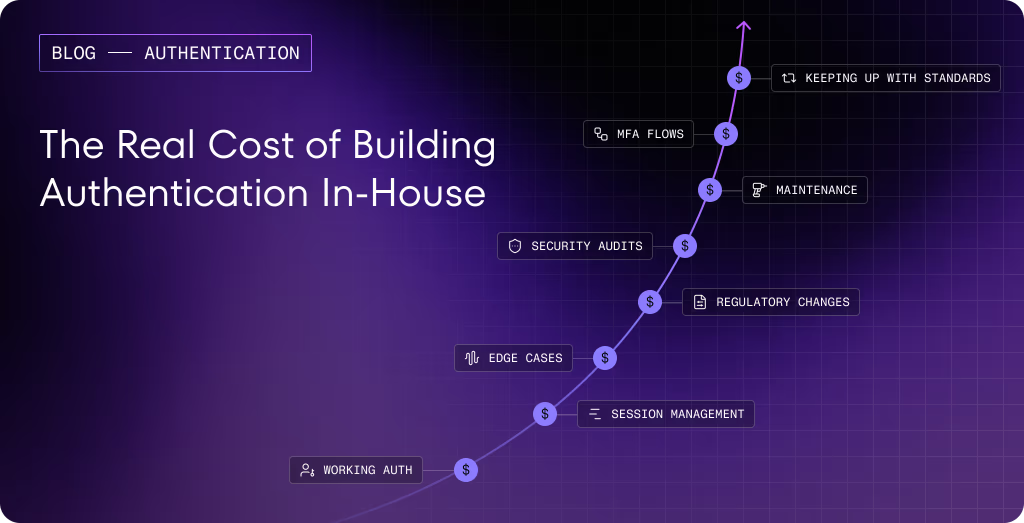
Most teams don't intentionally build weak authentication systems. It usually happens gradually.
A familiar authentication method gets implemented, users can log in, deadlines are met, and the product ships. Authentication appears to be working, so attention shifts to other priorities. The assumption is that improvements can always be made later.
Unfortunately, "later" often arrives unexpectedly.
It might start with a support ticket that reveals a recurring issue, an account compromise that shouldn't have happened, or an unexplained spike in costs caused by something like SMS pumping fraud. When organizations begin investigating these problems, they often trace back to an authentication decision that seemed perfectly reasonable at the time.
Authentication Is More Complex Than It Appears
At first glance, authentication seems straightforward. A user proves their identity, the system verifies it, and access is granted.
In reality, there are many interconnected decisions beneath the surface:
- How long should sessions remain active?
- What happens if a user loses access to their second factor?
- How should logins from unfamiliar devices be handled?
- What recovery options are available when the primary authentication method is unavailable?
- Does the recovery process undermine the security of the primary authentication method?
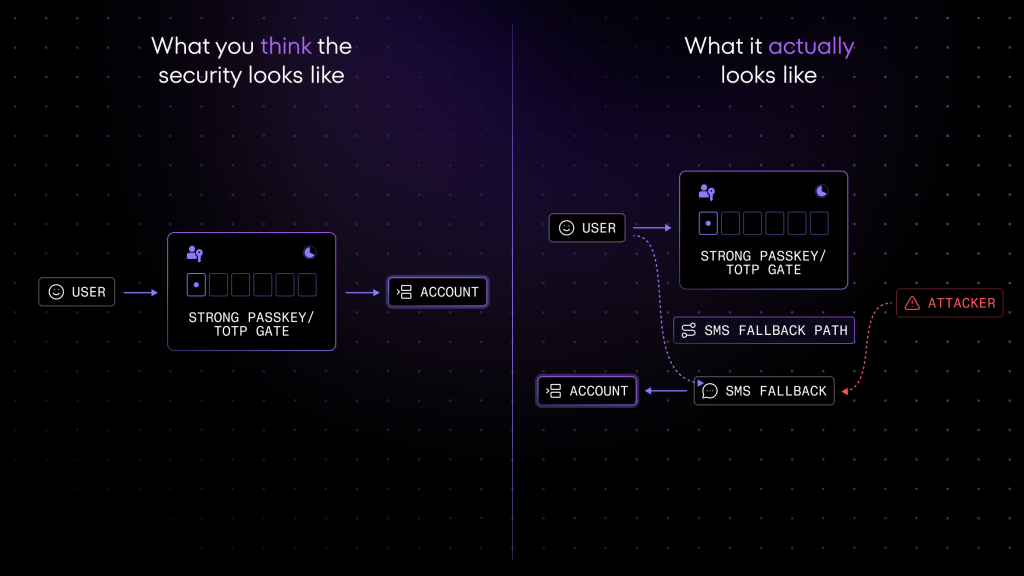
Many organizations strengthen authentication by introducing passkeys or other robust authentication factors while retaining SMS as a fallback option. Removing SMS often feels risky from a user experience perspective.
However, fallback mechanisms are only as secure as their weakest assumptions. If attackers can gain access through the recovery process, the strength of the primary authentication method becomes largely irrelevant.
Session management presents similar challenges. Long-lived tokens, incomplete session invalidation after logout, and refresh tokens that remain active longer than necessary may not appear dangerous initially. Yet these weaknesses are frequently discovered and exploited over time.
Organizations that build strong authentication systems often do so after experiencing one or more of these issues firsthand. Much of the industry's best practice knowledge has been learned through real-world incidents.
Another common misconception is that authentication encompasses the entire identity stack, including SSO, authorization, OIDC, and user management. While these components are related, authentication is a specialized discipline with its own challenges. Authentication flows, authentication factors, and recovery mechanisms require dedicated attention regardless of which identity provider is being used.
Many teams assume that implementing platforms such as Okta or Auth0 means authentication is fully addressed. In some cases it is, but authentication gaps often remain in areas that receive little scrutiny.
The Threat Landscape Continues to Evolve
The authentication system deployed a few years ago was designed for a different environment than the one organizations face today.
Phishing provides a clear example.
Traditional security guidance emphasized teaching users to identify warning signs such as poor grammar, suspicious sender addresses, and urgent messaging. Generative AI has fundamentally changed this landscape. Attackers can now create highly convincing and well-researched phishing campaigns at minimal cost, making user awareness alone insufficient as a defense strategy.
Account recovery processes have also become increasingly attractive targets. As primary authentication methods become stronger, attackers focus on weaker alternatives.
Recovery mechanisms such as:
- Security questions
- SMS-based account recovery
- Support-assisted account resets
often receive less attention than login workflows. If recovery is weaker than authentication, attackers will naturally target the recovery process.
Regulatory requirements are also evolving more rapidly than many organizations anticipate. This is particularly true in highly regulated sectors such as financial services, where requirements that do not apply today may become mandatory within a relatively short timeframe.
Discovering regulatory changes after they have already taken effect places organizations in a difficult position, yet this situation occurs more frequently than it should.
None of these developments are reasons for alarm. They do, however, highlight the importance of regularly assessing whether an authentication system remains effective and whether it can adapt without requiring extensive redevelopment.
This is one of the reasons authentication platforms such as Authsignal exist. The responsibility for keeping pace with changing standards, threats, and requirements is handled at the platform level rather than becoming another item on an organization's development roadmap.
Authentication Failures Are Often Invisible Until They Aren't
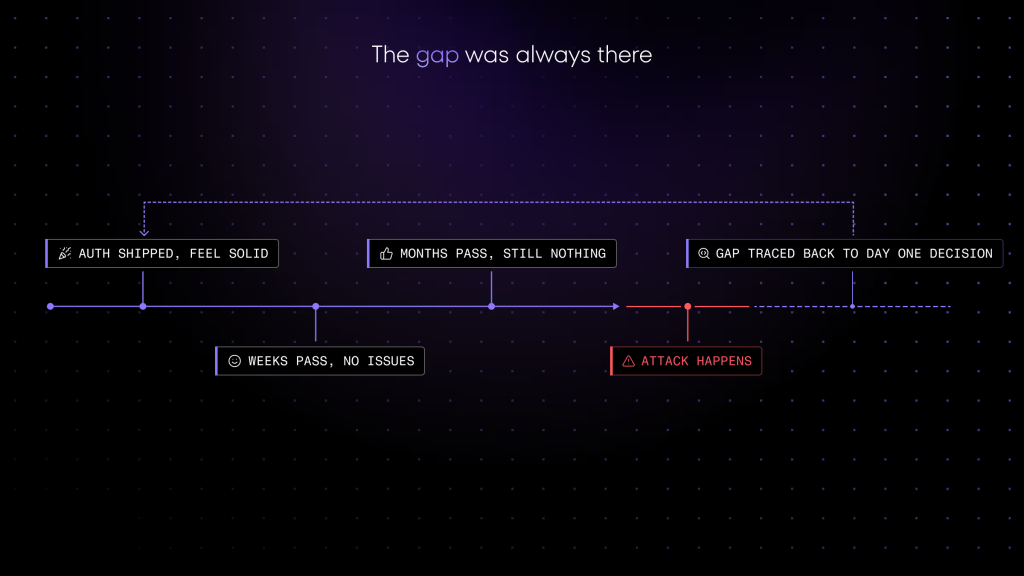
Most authentication failures do not initially appear as failures.
There are rarely alarms, obvious indicators, or immediate signs of compromise. Instead, small weaknesses persist unnoticed until an incident reveals them.
Replay attacks illustrate this challenge well.
Many OTP-based systems assume that a valid code proves the identity of the person submitting it. In practice, authentication codes can be intercepted through phishing attacks, malware infections, or real-time proxy systems that sit between users and legitimate websites.
An attacker who captures a valid code can submit it successfully. From the system's perspective, the authentication process has worked exactly as intended.
A 2024 Microsoft study found that more than 40% of users who experienced account takeovers had MFA enabled at the time. The MFA functioned correctly—the underlying design contained a gap.
SMS-based authentication introduces its own set of risks, including fraud scenarios capable of generating substantial unexpected costs. However, SMS is simply one example of a broader reality: every authentication method has limitations. The critical question is whether organizations identify those weaknesses before attackers do.
User Choice Improves Both Security and Experience
There is a version of secure authentication that performs perfectly in controlled testing environments but fails in production because real users do not behave like test users.
Not every user can adopt passkeys immediately. Device compatibility is not universal. Enterprise customers often arrive with established SSO requirements. Some users simply will not enroll in authenticator applications regardless of how clearly the benefits are explained.
If the only alternative is abandoning registration entirely, organizations risk losing legitimate customers because of authentication preferences.
This is why flexibility matters.
Not because every authentication method provides equal security, but because users frequently bypass systems that create excessive friction. A security solution that users actively avoid is often less effective than one designed around real-world behavior.
Supporting multiple authentication methods—including passkeys, TOTP, magic links, push notifications, biometrics, and sensible recovery options—reduces friction, improves onboarding experiences, and encourages adoption of stronger authentication methods.
The most secure option should also be the easiest option.
This is as much a design challenge as it is a technical one.
Authsignal is built around this principle. Rather than requiring organizations to integrate each authentication method separately, these capabilities are available through a single configurable platform. As customer expectations evolve, organizations are less likely to encounter situations where they must explain that a preferred authentication method is not yet supported.
Speed and Security No Longer Need to Be Trade-Offs
The belief that organizations must choose between rapid delivery and properly implemented authentication is increasingly outdated.
Historically, building secure authentication systems required significant development effort. Modern tooling has changed that equation.
Authentication interfaces are deceptively time-consuming to develop. Login screens, MFA enrollment workflows, step-up authentication challenges, and account recovery processes all appear straightforward until edge cases emerge—which they inevitably do.
By the time these experiences are thoroughly tested across browsers, devices, and operating systems, significant development time has often been consumed without delivering visible product innovation.
Pre-built authentication interfaces address this challenge by providing production-ready experiences that have already been tested extensively. Accessibility requirements are handled, edge cases are addressed, and implementation time is dramatically reduced.
The same principle applies to authentication challenges themselves.
Applying MFA to every login attempt creates unnecessary friction for legitimate users. A more effective approach evaluates contextual signals such as:
- Known devices
- Familiar locations
- Normal behavioral patterns
and only introduces additional verification when something appears unusual.
This approach simultaneously improves security and user experience.
Audit logging deserves special attention because it is frequently postponed and almost always regretted later.
Organizations rarely appreciate the value of audit logs until they need them for:
- Security investigations
- Compliance reviews
- Customer disputes
- Incident reconstruction
By that point, missing information cannot be recovered. Audit logging should be implemented from the beginning.
The Value of Starting with Experience
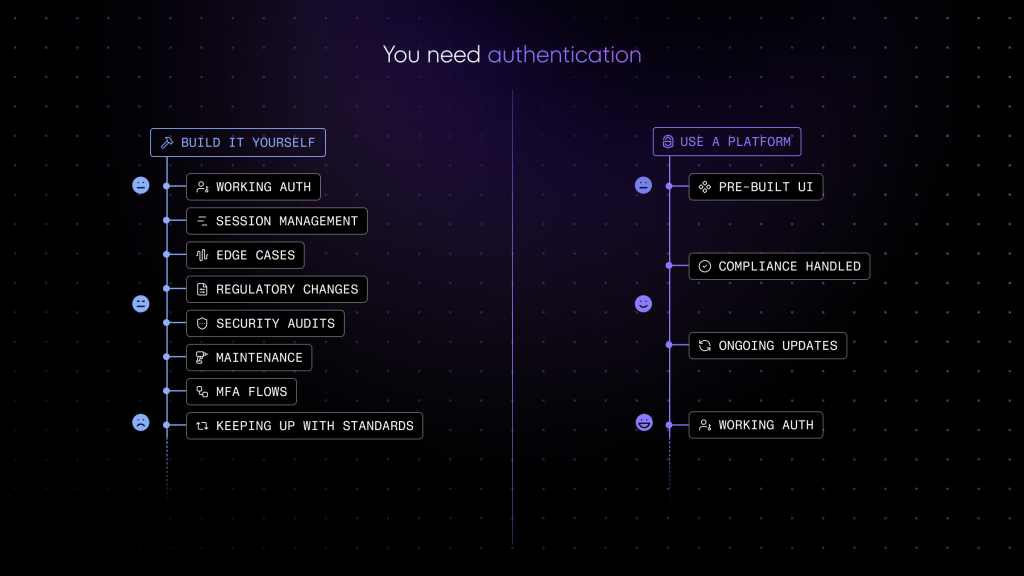
Authentication is a specialized discipline.
Organizations that excel at it have spent years developing expertise across hundreds of integrations, learning from security incidents, adapting to regulatory changes, maintaining libraries through breaking changes, and responding to newly discovered vulnerabilities.
This knowledge accumulates over time and is difficult to replicate quickly.
Building an authentication stack from scratch means absorbing all of these challenges while simultaneously trying to deliver a core product. Most teams underestimate the true cost until they are already committed.
Authsignal is built on the belief that organizations should not have to start from zero.
Passkeys, biometric authentication, TOTP, magic links, WhatsApp OTP, push notifications, and email OTP are available out of the box. Production-ready user interfaces reduce implementation effort. Risk-based decisioning adapts authentication requirements based on real-world signals. Audit logging is available from day one.
Most importantly, when standards evolve, new attack techniques emerge, or regulatory requirements change, those updates are managed at the platform level rather than becoming additional work for internal development teams.
About DT Asia
DT Asia began in 2007 with a clear mission to build the market entry for various pioneering IT security solutions from the US, Europe and Israel.
Today, DT Asia is a regional, value-added distributor of cybersecurity solutions providing cutting-edge technologies to key government organisations and top private sector clients including global banks and Fortune 500 companies. We have offices and partners around the Asia Pacific to better understand the markets and deliver localised solutions.
How we help
If you need to know more about the real cost of building authentication in-house, you’re in the right place, we’re here to help! DTA is Versasec’s distributor, especially in Singapore and Asia, our technicians have deep experience on the product and relevant technologies you can always trust, we provide this product’s turnkey solutions, including consultation, deployment, and maintenance service.
Click here and here and here to know more: https://dtasiagroup.com/authsignal/