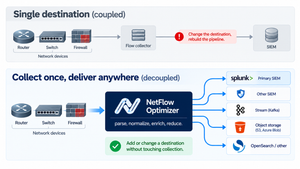
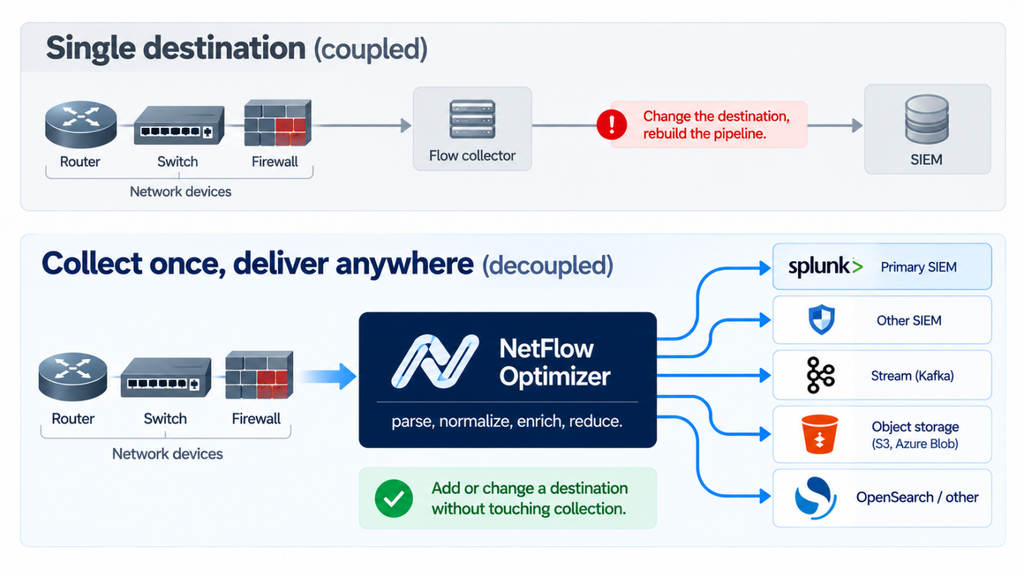
Most network telemetry pipelines still operate much the same way they did a decade ago. Network devices send their data to a collector connected to a single destination, typically a SIEM, and the pipeline remains unchanged.
This approach works until the destination needs to change.
Whether it is a SIEM migration, the introduction of a new security data lake, a data-residency requirement, or another team needing access to the same flow data through a different tool, a single-destination pipeline can quickly turn a simple change into a complex reconfiguration project.
The underlying problem is the unnecessary connection between two separate functions: collecting network telemetry and determining where that data should be delivered.
In a single-destination architecture, these functions are combined. As a result, whenever the downstream environment changes, the collection process may need to be reconfigured or redirected, even though the telemetry itself remains exactly the same. This includes the work involved in parsing binary flow data, normalizing records, and enriching telemetry.
A more flexible approach separates these responsibilities. Network telemetry is collected and processed once, then delivered to multiple destinations simultaneously. New destinations can be added or existing ones changed without modifying the collection process.
This is the architecture behind NetFlow Optimizer (NFO).
The Challenges of a Single-Destination Pipeline
When a network telemetry pipeline is designed around one destination, several common operational changes can become unnecessarily complicated.
- SIEM migration or consolidation. When a collector is directly connected to a legacy SIEM, moving to a new platform requires changes to the pipeline during the migration. This creates additional work at a time when maintaining uninterrupted visibility is particularly important.
- Introducing additional data consumers. Organizations may want to send telemetry to a data lake for long-term retention, a streaming platform for real-time processing, or an analytics solution used by another team. With a single-destination architecture, each additional consumer can require a separate integration project rather than simply adding another output.
- Data residency and sovereignty requirements. Certain telemetry may need to be stored in a specific geographical region or remain on-premises within a controlled environment. These requirements introduce additional complications when the existing pipeline was never designed to support multiple destinations.
- Storage costs and data tiering. Organizations may need to send enriched telemetry to hot, searchable storage while retaining another copy in a more cost-effective storage tier, such as a Splunk Machine Data Lake or object storage. This is straightforward when data delivery is independent of collection, but considerably more difficult when both functions are tightly connected.
In all these situations, the telemetry remains unchanged. Only the destination is different.
When collection and delivery are combined, every destination change introduces additional reconfiguration work.
Collecting network telemetry and deciding where it should go are two distinct responsibilities. Combining them turns every destination change into a pipeline project. Separating them makes adding a new destination as simple as configuring another output.
Collect and Process Once
NFO handles the essential processing tasks independently of downstream destinations, performing them just once.
It ingests binary NetFlow, IPFIX, sFlow, and J-Flow data exported by routers, switches, and firewalls. It also supports SNMP polling and Model-Driven Telemetry (MDT) to collect information about network device health.
Once collected, the data is parsed and normalized into a consistent schema. Each record is then enriched with additional context, including user identity, application information, threat intelligence, and geographic data.
Before the telemetry leaves the pipeline, NFO also reduces data volume by 80 to 90 percent, primarily through aggregation.
Importantly, none of these processing activities depends on the final destination.
Parsing, normalization, enrichment, and data reduction are completed once within the pipeline. The result is processed telemetry that is ready for consumption by different systems.
This means the destination is determined after the processing stage, rather than being a limitation built into the collection architecture.
Deliver to Multiple Destinations Simultaneously
After processing is complete, NFO can distribute the finished telemetry to the destinations that require it, including multiple destinations at the same time.
For most deployments, Splunk remains the primary SIEM. It receives enriched, CIM-compliant network telemetry that is ready for detection and threat hunting, supported by the NetFlow and SNMP Analytics for Splunk application.
The same processed telemetry can also be delivered simultaneously to other platforms and systems.
| Destination | Purpose |
|---|---|
| Splunk (Primary SIEM) | Supports detection, correlation, and threat hunting using enriched, CIM-compliant network data. |
| Microsoft Sentinel | Provides a secondary SIEM for another business unit or supports the transition to a new platform during a migration. |
| Apache Kafka | Enables real-time telemetry streaming into other systems and data pipelines. |
| Object Storage (Amazon S3, Azure Blob) | Supports cost-effective, long-term data retention. |
| Exabeam, OpenSearch, and Others | Provides telemetry to team-specific analytics tools or additional security platforms. |
Since data delivery is separated from collection, adding or changing a destination becomes a configuration change in one place.
Network devices continue exporting telemetry to NFO without needing to know which platforms receive the data downstream.
For example, during a SIEM migration, telemetry can be delivered to both the existing and new platforms in parallel. This allows organizations to validate the new environment before completing the transition, instead of relying on a potentially risky, one-time switch.
We explored this scenario in more detail in The Resilient NOC During a SIEM Migration.
Similarly, introducing a new data lake simply requires adding another output rather than building an entirely separate collection pipeline.
Why This Matters Beyond Convenience
Separating collection from delivery offers more than just reduced configuration work. It fundamentally changes how organizations can manage and use their network telemetry.
When the collection and enrichment layer operates independently of any particular destination, decisions about downstream platforms are no longer restricted by the existing pipeline.
Organizations can adopt a new SIEM, introduce a security data lake, stream telemetry into another system, or address new data-residency requirements through delivery changes rather than rebuilding the collection infrastructure.
This separation is also increasingly important for AI initiatives.
According to Splunk's Machine Data Outlook research, 53 percent of respondents frequently or always lack the machine data required for AI or automated decision-making.
One reason this can happen is that telemetry remains confined to a single destination. The data is already available, but it has not been delivered to the systems that need it.
This flexibility becomes especially valuable when organizations face unexpected changes, such as an acquisition that expands their technology environment, a new regulatory requirement that determines where data can be stored, or a SIEM migration where maintaining visibility is essential.
A pipeline designed to collect once and deliver anywhere can accommodate these changes more easily. In contrast, an architecture tied to a single destination creates additional limitations.
It is also important to understand NFO's role within this architecture. NFO is responsible for collecting, processing, and delivering network telemetry. Detection, correlation, and visualization remain the responsibilities of the destination platforms, including Splunk and other connected systems.
NFO's purpose is to ensure that the same enriched and normalized telemetry reaches all the required destinations without repeating the collection and processing work for each one.
The Bottom Line
Network telemetry should be collected and enriched once, then delivered to every destination that needs it.
Combining collection and delivery into a single-destination pipeline makes every SIEM migration, additional data consumer, and new data-residency requirement a reconfiguration project.
NetFlow Optimizer separates these responsibilities by parsing, normalizing, enriching, and reducing network telemetry once before distributing the processed data to Splunk and other destinations simultaneously.
New destinations can be introduced or existing ones changed without modifying the collection process.
Collect once. Deliver anywhere. Make the destination a decision, not a constraint.
About DT Asia
DT Asia began in 2007 with a clear mission to build the market entry for various pioneering IT security solutions from the US, Europe and Israel.
Today, DT Asia is a regional, value-added distributor of cybersecurity solutions providing cutting-edge technologies to key government organisations and top private sector clients including global banks and Fortune 500 companies. We have offices and partners around the Asia Pacific to better understand the markets and deliver localised solutions.
How we help
If you need to know more about Why Network Telemetry Should Not Be Tied to One Destination, you’re in the right place, we’re here to help! DTA is Netflow Logic’s distributor, especially in Singapore and Asia, our technicians have deep experience on the product and relevant technologies you can always trust, we provide this product’s turnkey solutions, including consultation, deployment, and maintenance service.
Click here and here and here to know more: https://dtasiagroup.com/netflowlogic/