The vision of an AI-powered Security Operations Center (SOC) is highly compelling: faster threat detection, automated investigations, reduced analyst workload, and security operations that can scale without requiring a proportional increase in headcount.
Security vendors have delivered many of these capabilities, but a significant number of AI SOC deployments have not achieved the expected results. The reason is often overlooked.
The challenge is not the AI.
The challenge is the data that feeds it.
Most enterprise security data was never designed for the machine-driven reasoning required by modern AI platforms. Instead, it was built for traditional SIEM environments where human analysts interpreted, queried, and worked around inconsistencies in the data.
That approach was manageable when humans were responsible for the reasoning process. In an AI-native SOC, those same inconsistencies become major limitations.
The Data Problem AI Vendors Don't Talk About
In most enterprise environments, security data typically looks like this:
- Unstructured events with inconsistent field names across different sources
- Different timestamp formats across systems
- Incomplete metadata
- Multiple log formats that change depending on how collectors were configured and maintained
A firewall log from one vendor may use completely different field names from another vendor’s firewall logs. Endpoint telemetry may arrive without important context. Cloud security events may include metadata that does not align with any common schema.
While AI platforms can technically ingest raw logs, their performance decreases significantly when data lacks structure and consistency.
Unstructured data forces AI systems to spend additional resources on preprocessing before analysis can even begin. This increases compute requirements, raises costs, reduces accuracy, and weakens the speed advantage that makes AI-driven security operations valuable.
This creates a common and frustrating situation: an organization invests in a next-generation AI SOC platform, connects it to existing security data sources, and discovers that the new technology still produces the same blind spots it was intended to solve.
The issue was never the AI technology.
The issue was the data foundation.
Open Schemas Are the Foundation of an AI-Ready SOC
The cybersecurity industry has increasingly adopted open standards that make security telemetry more structured, consistent, and usable by machines.
Open Cybersecurity Schema Framework (OCSF) provides a vendor-neutral data model that maps different security events into a common structure. This allows AI systems to analyze and correlate data across multiple sources without requiring custom translators for every individual source.
OpenTelemetry provides a similar foundation for logs, metrics, and traces on the observability side. This has become increasingly important as SOC teams combine application and infrastructure telemetry with traditional security data.
Other ecosystem-specific schemas, including Elastic Common Schema (ECS), Advanced Security Information Model (ASIM), and Common Information Model (CIM), remain highly relevant because many enterprise environments continue to rely on these formats.
Organizations achieving meaningful results from AI SOC platforms are typically those that have prioritized schema standardization at the ingestion layer.
When firewall events from different vendors are normalized into the same OCSF-compatible structure, AI platforms can correlate activity, identify patterns, and make decisions without repeatedly performing complex preprocessing whenever a new data format appears.
Axoflow supports this approach by providing parsers and transformations that convert vendor-specific telemetry into OCSF, ECS, ASIM, CIM, and other target schemas during collection. This allows downstream systems to receive structured data without needing to perform the same normalization work later.
Normalization Must Happen Before AI Processing
Many organizations have traditionally relied on their SIEM platform to handle data normalization. This approach worked when the SIEM was the primary destination for security analysis.
However, modern AI-driven security environments require a different approach.
AI platforms increasingly need to access multiple data repositories, analyze information across different data models, and support automated decision-making. Normalizing data only inside the SIEM creates limitations in these environments.
AI agents are not designed to automatically adapt when schemas change or when new data sources introduce different structures. Automation depends on reliable context and consistent event formats.
When those structures are inconsistent, automation can fail silently — creating one of the most dangerous failure scenarios in cybersecurity.
The solution is moving normalization upstream.
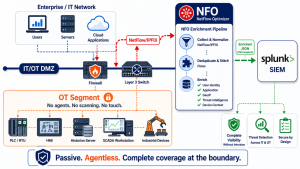
Instead of waiting until data reaches the analysis layer, organizations should classify, enrich, and transform events at the point of ingestion.
By converting security data into OCSF, OpenTelemetry, or other required schemas before it reaches downstream platforms:
- Data structures become predictable
- Fields become consistent
- Metadata becomes complete
- AI platforms can focus on analysis instead of data preparation
Reducing Noise Is Just as Important as Improving Data Quality
Data quality and data volume are closely connected.
Even properly structured data can create challenges when excessive amounts of information reach the AI layer. Redundant metadata, unnecessary fields, and large volumes of low-value events increase processing requirements and reduce the signal-to-noise ratio needed for effective AI-driven detection.
Intelligent filtering before data reaches AI platforms helps remove unnecessary noise while maintaining important security visibility.
The benefits include:
- Faster and more accurate detections
- Lower storage costs
- Improved AI performance
- More efficient security operations
Pipeline Visibility Is Essential
One of the most overlooked risks in AI SOC deployments is the invisible data pipeline problem.
Security data can disappear. Sources can stop sending telemetry. Configurations can change. Collection gaps can develop over time.
In a traditional SOC, analysts may discover these issues during an investigation. In an AI-driven SOC, the system may simply fail to identify threats because the necessary data never reached the model.
For this reason, deep visibility into telemetry flows — from source to destination — is not optional.
It is a requirement for trusting automated security decisions.
Open Formats Protect Long-Term Investment
The discussion around schemas is part of a larger question: who controls security data?
When security telemetry is stored in proprietary formats controlled by a single vendor, organizations become dependent on that vendor’s data structures and ecosystem.
Open formats change this relationship.
When security data is normalized into standards such as OCSF, OpenTelemetry, ECS, ASIM, or CIM, and stored using open formats like Parquet or Iceberg, organizations maintain control over their data.
This provides greater flexibility:
- AI SOC platforms can be changed without losing historical data
- Data lakes can be migrated more easily
- Detection engines can evolve independently
- Organizations avoid unnecessary vendor lock-in
The strongest SOC architectures are moving toward this model not because open formats are simply a trend, but because they allow organizations to maintain control in a rapidly evolving AI security market.
The Foundation That Makes AI SOC Successful
AI-native security operations require more than advanced AI capabilities.
They require an AI-ready data foundation.
This means:
- Schema-based normalization and enrichment at ingestion using open standards such as OCSF and OpenTelemetry
- Intelligent filtering before data reaches downstream security tools
- Complete visibility across telemetry pipelines
- Open storage formats that preserve organizational control over security data
AI SOC platforms are becoming increasingly capable.
However, for many organizations, the underlying data layer is still not ready.
Closing this gap through open schemas, open formats, and a modern security data pipeline architecture is where organizations will achieve the greatest value from their AI SOC investments.
About DT Asia
DT Asia began in 2007 with a clear mission to build the market entry for various pioneering IT security solutions from the US, Europe and Israel.
Today, DT Asia is a regional, value-added distributor of cybersecurity solutions providing cutting-edge technologies to key government organisations and top private sector clients including global banks and Fortune 500 companies. We have offices and partners around the Asia Pacific to better understand the markets and deliver localised solutions.
How we help
If you need to know more about Why Your AI SOC Is Only as Good as the Data Feeding It, you’re in the right place, we’re here to help! DTA is Quest Software’s distributor, especially in Singapore and Asia, our technicians have deep experience on the product and relevant technologies you can always trust, we provide this product’s turnkey solutions, including consultation, deployment, and maintenance service.
Click here and here and here to know more: https://dtasiagroup.com/axoflow/